
SAI using sulfur dioxide (SO2) (as we assume here) involves adding a highly toxic gas to the atmosphere. The possible impacts on human health driven by changes to the composition of the air we breathe are therefore a major concern for many. However, perhaps counterintuitively, the descent of injected sulfur is not the dominant mechanism by which sulfur-based SAI is expected to influence air quality. While descending aerosols contribute to PM2.5, this impact is reduced by the wide geographic area over which they descend and the relatively modest total injection magnitudes relative to other emissions sources (Wang et al., 2026). Eastham et al. (2018) suggest that a 1°C cooling with SAI produces a sulfur contribution to PM2.5 from descending aerosols approximately equal to that from global aviation. Larger impacts on air quality are expected from the changes to near-surface temperature and precipitation due to SAI, and from changes to surface ozone driven by stratospheric chemistry, atmospheric dynamics and altered UV radiation in the troposphere.
Metric
There is a 2% increase in mortality from PM2.5 and surface ozone under SAI relative to the no-SAI future, at 0.5°C global cooling. (see notes at the bottom of the "Further Information" for additional context)
Uncertainty
Wang et al. (2026) finds that mortality would decrease from ARISE to SSP2-4.5 in 2060-2069 by 0.4%, with an increase of at most around 2% according to their error estimate (Fig. 1, below). Eastham et al. (2018) finds a 21,500 person increase in mortality in an SAI scenario compared to a future SSP scenario. This absolute number is within the margin of error dictated by the percent change in Wang. Given the significant process uncertainties previously discussed, the relatively small amount of research, and the overall results discussed above, we believe there is a plausible possibility (10-50% chance) that the mortality increase due to SAI exceeds 2%. Note that future changes in population distributions might alter these estimates, but are not included in this analysis due to their difficulty to predict.
Decision relevance
The slight potential increase in mortality relative to the future baseline is greatly overshadowed by the significant overall future mortality reduction expected from decreased pollution and fossil fuel use, with or without SAI. Additionally, it is important to note that a majority of these changes are likely driven by decreased radiative forcing (Eastham et al., 2018), and therefore are not specific to SAI, but apply for any mitigation of climate change. Reductions in PM2.5 caused by a decrease in wildfire due to SAI (Tang et al., 2023) may not be fully captured in the assessments discussed here. Lastly, Wang et al. (2026) notes that the estimated changes to mortality through air quality changes due to SAI fall within the range of internal variability relative to the sizable decreases in mortality under SSP2-4.5, meaning that the signal of decreased mortality in the future greatly overshadows the potential change caused by SAI.
Further Information
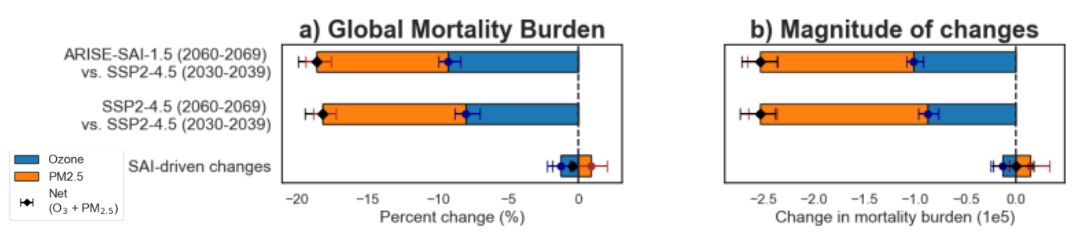
Figure 1, from Wang et al. (2026): Change in global mortality burden in future scenarios. Note that “SAI-driven changes” refers to the difference in ARISE-SAI-1.5 vs. SSP2-4.5 in 2060-2069, not direct aerosol forcing.
When we discuss surface air quality changes here, we are referring to SAI induced changes in PM2.5 and surface ozone. There are two common ways in which we can analyze these changes: first by comparing a future SAI scenario with the present-day state, and second by comparing a future SAI scenario with a future state under the background emissions pathway during the same time period. We choose the latter here, because reductions in emissions under future emissions scenarios can lead to decreased PM2.5 and surface ozone relative to the present-day, regardless of SAI implementation. Under the SSP2-4.5 emissions scenario, these changes due to emissions reductions are much larger than SAI-driven changes (Wang et al., 2026). By assessing the SAI scenario against a warmer world without SAI (i.e. the background SSP2-4.5 scenario), we include air quality changes caused by temperature change as being “SAI-driven”, but we note that this component of the changes might also result from other forms of climate change mitigation (Eastham et al., 2018; Harding et al., 2024).
PM2.5
Sulfate deposition
Surface-level sulfate emissions induce approximately 25 times more population exposure to PM2.5 than stratospheric emissions per unit mass (Eastham et al. 2018). Injection magnitudes under SAI are also expected to be well below current SO2 emissions, even for very large amounts of cooling (Visioni et al., 2020). Due to both of these factors, and because settling stratospheric sulfate aerosols produce larger particles than tropospheric emissions (Wang et al., 2026), changes to sulfur PM2.5 at the global scale are mostly driven by the expected reductions in tropospheric emissions in future emissions scenarios (Wang et al., 2026). Despite this, some areas with little background pollution might see large local increases in sulfate deposition relative to this background rate (Visioni et al., 2020).
Major PM2.5 change pathways
PM2.5 under SAI is also influenced by changes to atmospheric circulation and precipitation. Increased precipitation enhances wet scavenging and therefore decreases PM2.5 levels (Wang et al., 2026), while decreased precipitation has the opposite effect (Eastham et al., 2018). These changes must be assessed at the local rather than global scale, and we view them here as an important factor towards determining uncertainty in surface air quality changes under SAI. There are also aerosol-tranport impacts on PM2.5 levels as a result of circulation changes (Wang et al., 2026), but the specifics of these are not explored in depth in the literature.
Additionally, Eastham et al. (2018) notes that reduced temperatures lead to enhanced partitioning of HNO3 from background emissions into nitrate aerosol, increasing PM2.5 levels. The study cites this as the primary driver of SAI-induced PM2.5 changes.
Lastly, PM2.5 changes due to wildfire reduction will also have an impact and may not be fully captured by the above studies. While there is no literature specifically quantifying the link between a decreased wildfire occurrence and PM2.5 decrease, Tang et al. (2023) does note that SAI will decrease wildfires relative to SSP scenarios.
Surface ozone
There are a few mechanisms of surface ozone changes under an SAI future. First, increased stratospheric ozone depletion due to heterogeneous chemistry changes lead to decreased surface ozone through the stratosphere-troposphere exchange (STE) (Wang et al., 2026; Xia et al., 2017). Second, tropospheric chemistry changes resulting from decreased surface water vapor will increase surface ozone levels, while changes in SAI-driven changes in UV-flux will have a negative effect (Wang et al., 2026; Moch et al., 2023). Please note this is not a comprehensive list, rather a discussion of the main pathways.
Tropospheric chemistry and photolysis
Surface cooling as a result of SAI will lead to decreased surface water vapor. This will in turn decrease chemical ozone loss and lead to higher ozone amounts in the troposphere and is the dominant driver of surface ozone changes in the ARISE scenario in Wang et al. (2026). A second mechanism, not included in that study, is that increased UV flux due to decreased stratospheric ozone could increase tropospheric ozone photolysis rates and thus decrease global surface ozone levels (Moch et al., 2023).
Stratosphere-troposphere exchange (STE)
STE is altered in a few ways under SAI that impact surface ozone. These include aerosol driven ozone loss in the stratosphere, along with circulation impacts such as polar vortex strength and large-scale stratospheric transport (Wang et al., 2026). Xia et al. (2017) and Wang et al. (2026) observe decreases in tropospheric ozone under SAI largely due to decreasing stratospheric ozone. This impact is also largely scenario dependent and linked to the location of injections; in the ARISE scenario (primarily SH injection) changes to STE decrease surface ozone in the SH by up to 2 ppb, but is not the main driver of tropospheric ozone changes in the NH (Wang et al., 2026).
Overall, the changes to surface ozone through the above pathways are more than a factor of ten smaller than the U.S. EPA limit (70 ppb) (United States Environmental Protection Agency, 2025). Wang et al. (2026) find a surface ozone increase of 2 ppb in the NH and decrease of 2 ppb in the SH, while Moch et al. (2023) find a 1.6 ppb global surface ozone decrease due to the UV-flux pathway.
Notes about the metric
- This increase is around 10x smaller than the decrease in mortality from these sources in both SAI and future warming scenarios compared to current levels (Fig. 1)
- There is significant regional uncertainty in air quality response, but limited research prevents us from defining a quantitative metric in terms of regional changes.
- This metric includes radiative forcing/climate driven air quality changes as attributable to SAI.
References
7Have feedback on this entry?
Spot something off, missing, or worth adding? We’d love to hear from you.
Share feedback