
Aerosol particles exist over a range of sizes (the distribution). The size of the aerosols directly affects both their efficiency at scattering incoming solar radiation and how quickly they fall out of the stratosphere (Figure 1, below). Aerosol size is often characterized by the ‘effective radius’, an average measure of the size “seen” by incoming sunlight, although this quantity does not fully describe the distribution, since its shape and width also vary. The microphysical processes that determine the size distribution are quite uncertain and depend non-linearly on concentrations. The physical processes that set those concentrations are also uncertain, leading to potentially large errors in aerosol size estimation.
Metric
The global aerosol effective radius of stratospheric sulfate is >0.5 μm, under 21km 30°N/S injection at 5Tg annual injection
Uncertainty
An effective radius greater than 0.5 μm is approximately equal to a drop in forcing efficiency per unit injection of a factor of two relative to the four-model mean of recent earth system model simulations (G6-1.5K-SAI) simulating this form of SAI. While 0.5 μm effective radius is marginally outside the multi-model range from recent simulations, these models have common limitations which mean this range may well underestimate the true uncertainty. We judge that a size distribution with effective radius larger than 0.5 μm is not improbable, consistent with our medium uncertainty.
Decision relevance
We judge this uncertainty to have high decision relevance since a factor of two change in the one of the most fundamental quantities pertaining to SAI (how much material is required) would make informed decision making on SAI difficult and damage confidence in our ability to model its impacts. There is also a non-negligible risk that large deviations from the current estimate of size distributions might necessitate substantial changes to deployment methods.
Further Information
If SO2 were to be injected by an airplane, first it would mix in the plane wake, entraining surrounding air. Then the plume would be stretched and folded by background stratospheric winds, with intermittent small-scale turbulence causing dilution. Meanwhile, the SO2 would oxidize to H2SO4 via well-characterized reactions with OH, and each H2SO4 molecule would then either attach to an existing aerosol (condensation) or collide with another molecule of H2SO4, potentially starting a new aerosol particle (nucleation). Existing aerosol particles that collide can adhere to form larger particles (coagulation). Aerosol particles settle out gravitationally according to their size (sedimentation). The combination of these processes determines the ultimate size distribution. If instead of SO2, H2SO4 were injected, the size distribution would be more tightly controlled, but this method of deployment would add new engineering challenges.
The size distribution uncertainty is closely related to the aerosol transport uncertainty, because, first, larger aerosols fall out of the stratosphere faster, and second, longer lifetimes give aerosols more time to grow large.
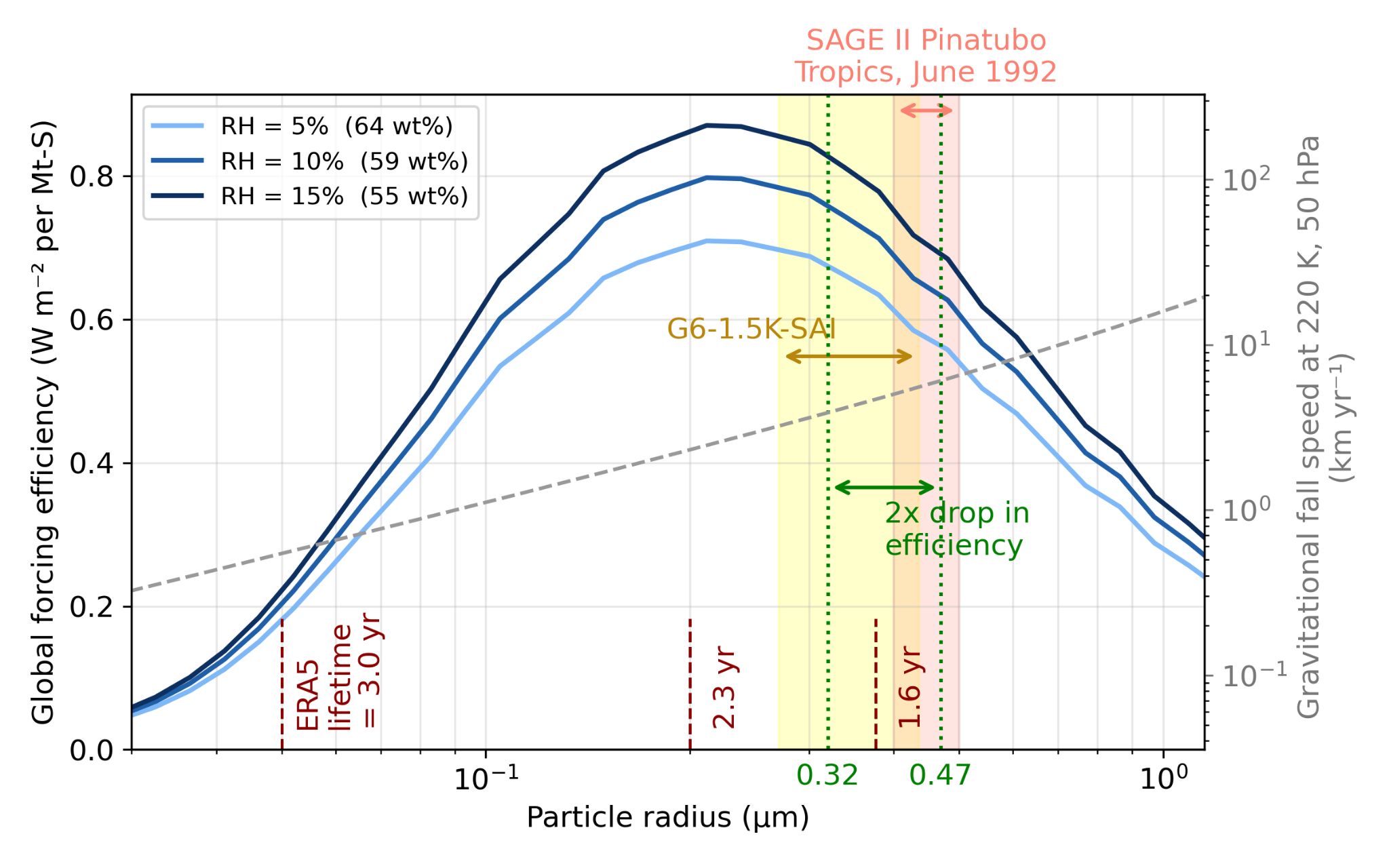
Figure 1: Radiative forcing efficiency (in global mean Wm-2 per Mt S stratospheric burden) as a function of sulfate aerosol radius, calculated using Mie theory for a globally uniform, thin, monodisperse aerosol layer, with scattering integrated over the whole solar spectrum (left axis). The dashed gray line shows fall speed as a function of radius (right axis), calculated using Stoke’s law including the Cunningham slip correction, with parameters chosen to represent a 20km altitude (50hPa, 220K). Lifetimes for SAI injection uniformly across the tropics, as simulated in Sun et al. (2023) using Lagrangian trajectories forced with ERA5 reanalysis are shown as dark red vertical dashed lines from the x-axis. Plotted values are read from Sun et al.’s Figure S1, for the 21km injection altitude. Observed aerosol effective radii from SAGE II after the Pinatubo eruption are shaded in light pink. The range here is the uncertainty for the Tropics at 50hPa, where the aerosol burden was maximum as read from Figure S9 in of Quaglia et al. (2023). The range in global aerosol effective radius across G6-1.5K-SAI simulations in the four available models (UKESM1, CESM2-WACCM, MIROC-ES2H, and E3SMv3) is shaded in yellow, averaged over 2065-2084 – see Lee et al. (2026) for latitude-altitude maps of this quantity. The two vertical green dashed lines indicate the four-model mean (0.32 μm) and the size required to halve efficacy relative to this value, estimated based on the variation in scattering, fall speed, and lifetime shown in the Figure. Code to reproduce this Figure runs on the Reflective Cloud Hub and is publicly available on GitHub.
Explain the decision relevance
Uncertainty in size distribution controls the magnitude of forcing for a given burden of aerosol and also impacts lifetime, so is a large contributor to the overall uncertainty in cooling per unit injection. Increasing particle radius from 0.35 μm to 0.5 μm approximately halves the cooling efficiency per unit injection because of the simultaneous reduction in both sunlight reflection per particle and particle lifetime (Figure 1). There is a small but non-zero risk that small-scale behavior dramatically changes our assessment of the effectiveness of SAI, potentially limiting the maximum achievable cooling, requiring use of a different aerosol precursor, or necessitating novel means of distributing the material.
Size distribution also controls the SW to LW forcing ratio, which determines the strength of stratospheric heating under SAI, which in turn impacts the stratospheric water vapor, the circulation response and regional climate. This means that if injection were scaled up to achieve the same global mean temperature with the reduced efficiency of larger particles, the surface effects of SAI would differ.
Explain sources of uncertainty and state of understanding
The steady-state aerosol size distribution under a particular injection strategy varies between earth system models, with a range in effective radius of roughly a factor of two for the most recent GeoMIP simulations of 30°N/S injection at 21km (G6-1.5K-SAI), as shown in Figure 1. These models do not account for uncertainties in mixing at small scales (near the plane or in the plume), as they have concentrations spread uniformly across approximately 100 km (horizontal scale) gridboxes. They also all share similar, modal, representations of aerosols, which could bias them in the same direction. For example, Laakso et al. (2022) find that changing from a modal to a sectional aerosol scheme increases effective radius by 50% (from 0.4 to 0.65 μm in their study).
In addition, most of these models use a nucleation scheme developed for the troposphere that overestimates new particle formation by orders of magnitude compared to chamber experiments (Yu et al. 2023). True nucleation rates may therefore be vastly different than what is represented in models. Finally, it is possible that model tuning towards a limited set of observed aerosol distributions after recent eruptions (particularly the eruption of Pinatubo in 1991) has artificially reduced the model spread. The earth system model range is therefore potentially a large underestimate of the true uncertainty in the aerosol size distribution.
Aerosol distributions following volcanic injection are a useful comparison, but an imperfect analog for SAI. Volcanic eruptions add ash and other material alongside SO2, do not sustain their injection over many years as in the SAI case, and have a much larger spatial scale of injection than a plume from an aircraft. Additionally, the record of large sulfur-rich eruptions in the satellite era is limited, and the effect of eruptions on the sulfate aerosol distribution varies widely between eruptions due to variation in both eruption parameters and the background stratospheric conditions (including winds, water vapor concentrations, location and time of year). The fact that the size distribution after the 1991 Pinatubo eruption overlaps the multi-model range in effective radius gives some reassurance of model performance, but even this test should be treated with caution since the Pinatubo response is one of few observational benchmarks for model development (e.g. Dhomse et al., 2020).
Future research directions
Further modeling studies which could reduce uncertainty include assessments of the effect of improved aerosol representation, such as comparing sectional versus modal aerosol schemes (Eastham et al., 2025) in earth system models, as well as new earth system model intercomparisons (under GeoMIP) and the simulation of SAI in new models. One near-term activity which could better quantify the effect of inter-model spread in size distribution would be an analysis of the radiative effects of the difference in the full size distributions (not just the effective radii, as in Figure 1, above) between current models.
Beyond modelling, chamber experiments may reduce some uncertainties,such as those associated with H2SO4 nucleation. However, outdoor experiments involving small-scale SO2 releases are likely required to substantially reduce the uncertainties related to wake-mixing, dispersion, and nucleation, which control the resulting evolution of aerosol size.
References
9Have feedback on this entry?
Spot something off, missing, or worth adding? We’d love to hear from you.
Share feedback